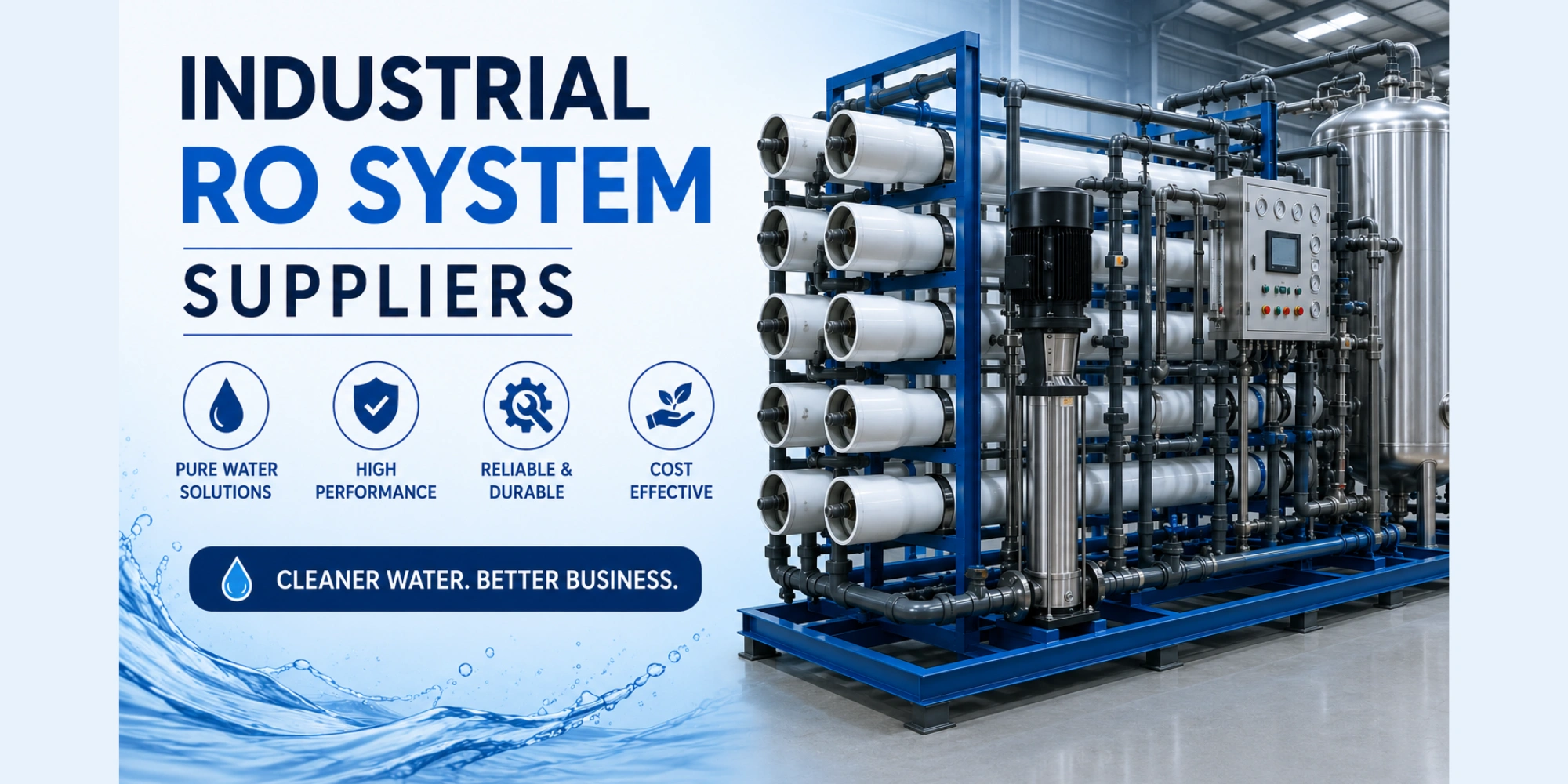
Industrial RO System Suppliers Hyderabad: A Handy Business Guide
Picking the right Industrial RO system suppliers in Hyderabad is essential for companies that rely on consistent water quality. No matter if the required water is for a manufacturing facility, a hotel, hospital, food processing center, pharmaceutical manufacturing, a commercial building, or any other industrial application, an appropriate RO system can impact water quality and overall process efficiency and can help manage long-term maintenance. An industrial RO system cannot be a large domestic water purifier. In our context, an industrial RO system is a water treatment system built around the parameters of feed water, production, recovery, operating pressure, irrigation system requirements, and the quality of water at the end of the process. Therefore, selection of the supplier based on the lowest quote can be a dangerous choice. The supplier must be able to handle the water chemistry, suggest appropriate pretreatment, select suitable membranes, pumps, and design the plant, provide installation and carry on the after-sales responsibility. The Bureau of Indian Standards is in the process of publishing IS 16240:2023 for reverse osmosis-based systems for drinking water treatment at the point of use, and Indian regulations cover management and use of rejected water from RO systems.
Understanding Industrial RO Systems
An industrial reverse osmosis (RO) system is based on pressure-driven water treatment technology. Water is pushed through a semi-permeable membrane where water pass through and most dissolved substances and contaminants are retained. RO systems treat water and produce a concentrate stream. An RO plant’s specific performance depends on various factors including the quality of influent water, membrane selected, pressure, temperature, pretreatment, recovery goal, and other process and operational parameters. Hence, a standard machine recommendation by an industrial RO plant supplier in Hyderabad should be preceded by analyzing the water. The desired RO system design is impacted by the influent water quality (TDS, hardness, silica, iron, manganese, turbidity, pH, chlorine, micro-organisms, etc.), site conditions and design specific requirements. As per BIS, reverse osmosis involves applying pressure on a water stream to flow through a semi-permeable membrane, and its current drinking water reverse osmosis standard focuses on performance and test requirements for point-of-use systems.
An Overview of How an Industrial RO System Works
Compared to residential set-ups, most industrial RO systems rely on a combination of treatments, and use an RO membrane as the last step. Raw water is first treated through a feed water storage tank, before being subjected to multimedia and activated carbon filters, dosing for softening or antiscalant, cartridge filtration, and a final high pressure pump for the RO membrane. The purpose of pretreatment is to eliminate the membrane from the threat of suspended solids, chlorine, the hardness related scaling, and other efficiencies decreasing agents. The permeate or product water is collected for the industrial application of choice, while the concentrate or reject water is managed separately. An RO membrane in the context of water treatment systems is considered the final barrier or gate of fine filtration. The impact of all downstream processes cannot be overstated, as the treatment journey has a tremendous impact on the membrane and its efficiencies. A quality systems integrator is able to look beyond the RO membrane and package the complete treatment solution.
Water Needs Vary Between Industries: Treating Water with R.O. Systems
Treating water for varied industry needs is critical. Hard or improperly treated water can affect equipment, production, cleaning processes, and finished goods. Industries located near regions that have underground water sources that are high in hardness or contain substantial dissolved solids may require an RO based water treatment system. With the growing commercial and industrial space in Hyderabad, the demand for water treatment systems will continue to rise. Treating water is essential for businesses to continue operations, however, each location has its own unique challenges. Some sites may require compact water treatment systems, while others may require multi-stage processes that include automation, chemical treatment, and water storage along with systems that continuously monitor water quality. It is important to consider the end goal in the design of the water treatment system.
Common Water Quality Challenges
Industrial water treatment needs include dissolved salts and other challenges related to hardness and softness, suspended and dissolved solids, organic matter, and contaminants. Water that has high salts and hardness can leave a scale on equipment from hardness that causes white spotting on glass, and insufficiently treated solids can cause fouling on equipment. Chlorinated and oxidized water, for instance, can damage RO membranes. Therefore, during the design of a water treatment system, walk-ahead optimization and caring for the membrane are critical. Two businesses that are situated in the same city can have significant differences in feed water challenges, and as such, RO based industrial water systems in Hyderabad should be designed after considering the results of a recent water quality analysis.
Applications of Industrial RO Plants
Water treatment through the use of Industrial RO plants can be designed for a wide variety of applications where a large quantity of treated water is required. Treated water can be utilized for the processing and preparation of ingredients and equipment cleaning in the food and beverage industries, based on their specific requirements. Hotels, hospitals, schools, labs, and commercial buildings, as well as manufacturing, can use RO water for various activities. In addition, treated water can be utilized in production and equipment support activities, as well as for process utilities in manufacturing. Pharmaceutical and specialty industries may require RO water to be used in conjunction with other specialized purification systems to meet the high standards of water quality that their processes may require. It is vital to have an RO system designed specifically for the application it will serve, as opposed to buying an off-the-shelf system.
What to Look for in Industrial RO System Suppliers
When choosing Industrial RO System Suppliers in Hyderabad, do not evaluate solely based on machine capacity. A professional supplier should justify their selection for membrane configuration, pumps, pretreatment systems, recovery percentage, and automation packages. Be sure to ask from which feed-water analysis they based their design, and if they will provide a process-flow diagram and technical specification prior to the installation. Most importantly, know exactly what you are getting for the money you are spending. The fundamentals of a project are membranes, pumps, pretreatment, controls, and instrumentation. From there, quite a bit can be added to the package to include piping, installation, commissioning, operator training, and warranties. Be mindful of the terms you are paying for and how they affect the final cost. A complete quote is essential since you are dealing with complete systems.
System Capacity and Recovery
The capacity of a system is defined as the volume of treated water produced in a given time period. However, the capacity of the system should not be analyzed in isolation. Recovery is the percentage of feed water that is converted into product water with the remaining water becoming concentrate or reject. There should be a balance between system capacity and recovery to minimize the amount of water that is lost as concentrate. There is a risk of increasing the likelihood of scaling and fouling due to air entrainment if recovery is pushed too far. The goal to minimize system cost should be balanced against the negative effects of increases in system capacity. A supplier should not simply cite a recovery and capacity percentage on a proposal without providing the rationale for their position.
Membrane and Pretreatment Selection
In most industrial systems, RO membranes play a very important role, but there is a strong dependence of membrane performance of system conditions prior to the membranes. Suspended solids are removed by multimedia filters, by activated carbon for certain types of organic and chlorine contamination, and by chemical scaling control. The final stage of pretreatment before the membrane system is usually cartridge filtration. The choice of pretreatment is significantly influenced by the raw water analysis, and as such a reliable RO membrane supplier in Hyderabad should not only focus on brand promotion of membranes, but on the RO pretreatment as well.
Types of Industrial RO Systems
As in all other industries, flexibility is important, especially in the design of Industrial RO systems. Based on the available space, the intended application, and the quality of the feed water, Industrial RO systems can be designed as single high capacity modules, or multiple modules. Large systems may require multiple skids, or even RO systems integrated with other treatment stages and processes such as UV or Ozone. Demineralization can be used for final polishing along with other late stage treatment. Preferably, system designs should be based on process requirements and analysis of the water, because over-sizing a system can lead to unnecessary cost burdens.
Skid-Mounted RO Plants
Skid-mounted RO plants are very flexible in the design of primary and support equipment. The contractor creates structural frames and mounts most, if not all, equipment on them. The benefit of this design over the modular frame design is the ease of transportation, installation, piping, and also the commissioning of the equipment. Several components of the system including membrane housings, pumps, filters, instruments, control valves, and associated piping systems can be pre-assembled and stored in a compact footprint. The use of skid-mounted designs is optimal for industries in Hyderabad as it maximizes the flexibility of design with the benefits of easy assembly.
High-Recovery RO Systems
High-recovery RO systems increase operational water efficiency as they minimize feed water requirements to produce the same amount of product water. However, there are problems with increasing recovery, particularly with respect to the concentration of scaler dissolved solids. This calls for appropriate pretreatment and antiscalants, membrane selection, system staging, and adjustments to the operating controls. A supplier claiming a particular recovery will become the selling point of the systems must be challenged to provide a justification in terms of the water chemistry showing that the targeted recovery is technically defensible.
Components of an Industrial RO System
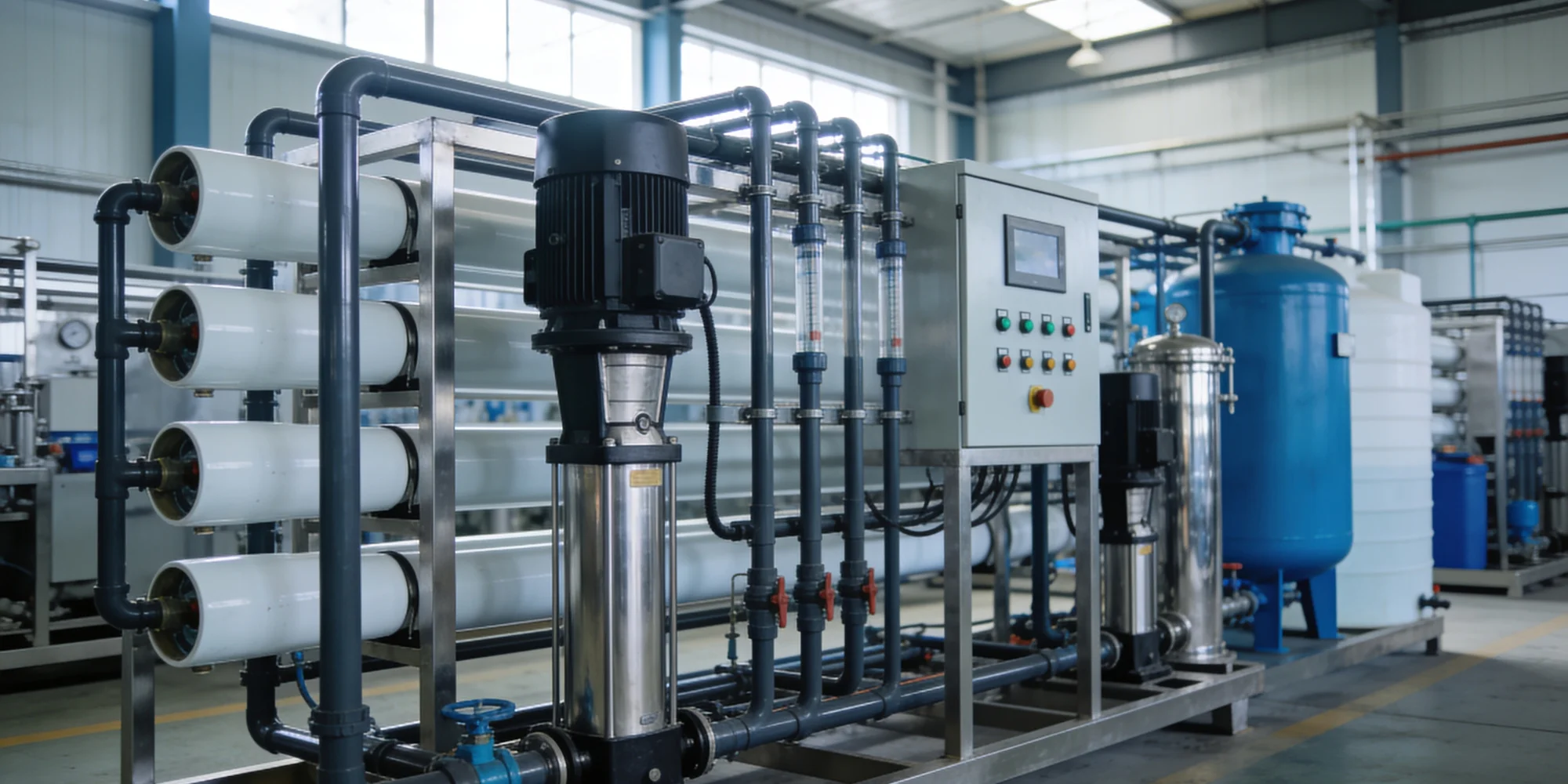
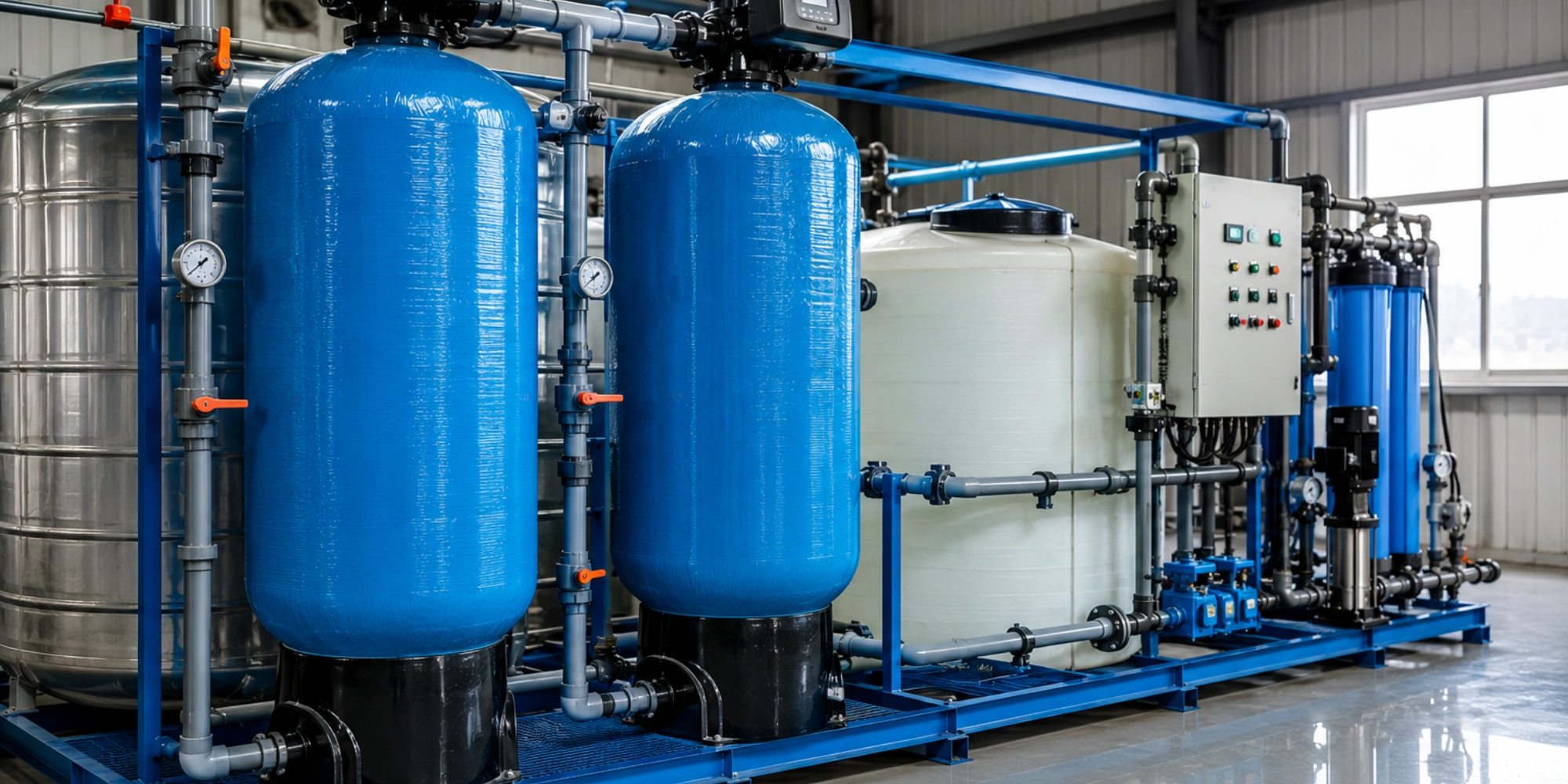
Industrial RO systems consist of a collection of subsystems and equipment that perform water treatment in a step-wise fashion. The equipment may consist of raw water storage, feed pumps, multimedia filters, activated carbon filters, softeners, dosing systems, cartridge filters, high pressure pumps, membrane pressure vessels, RO membranes, flow, pressure, conductivity/TDS meters, and product water and reject water tanks. In addition, final treatment systems and water reuse systems may require additional disinfection, polishing, remineralization, and other kinds of subsystems. The quality and integrity of the component parts of the system are critical because the failure of a small part can compromise the entire system.
Instrumentation is especially important for product water quality. Fouling or flow problems are indicative of process issues. Conductivity readings may help to assess the quality of the product water. Flow meters give operators a means to compare actual and expected values. Certain control systems may benefit from an automated shutdown or equipment protecting alarm system. A control system supplier that provides a user friendly instrumentation system and control logic simplifies the operation and troubleshooting of the entire control system.
Advantages of an Industrial RO Plant
The greatest advantage of a well-designed Industrial RO system is the reliable production of treated water. Rather than relying wholly on the variable quality of raw water, the system can introduce intentional treatment stages based on the requirements of the specific process. Depending on the feed water and the configuration of the membrane, reverse osmosis can remove a large portion of dissolved salts and other impurities. The water produced can be used in a number of industrial processes, in utilities, in various cleaning processes, and in any other applications which require water with a lower degree of dissolved solids. The quality of the water should not be assumed based on the word "RO." It should be determined with the proper testing.
There can be additional operational benefits as well. Improved water quality may help to reduce the formation of scale and deposits in certain pieces of water-using equipment, thus possibly resulting in a more reliable and predictable maintenance schedule. In certain applications, treated water may actually improve the consistency of the process. With the proper engineering, the plant can be designed to make the daily operation of the system easier for the staff through the use of automation, alarms, and monitoring. The benefits of the system will be the greatest when the system is designed correctly. Even the most expensive RO system will not perform well if the pre-treatment is substandard and the membranes are not cared for.
How to Determine the Correct RO Capacity
To determine appropriate capacity for reverse osmosis (RO) systems, knowledge of water demand is required. Consider daily and peak demands. Decisions are best made after determining the volume of treated water consumed, consumption time, and demand variations (if any) across shifts and production cycles. Storage capacity helps mitigate demand spikes and allows the RO system to run for a specified time while the treated water is stored in a tank. Designing a system to meet only average demand is a gamble; the system may not meet peak demand. Conversely, demand significantly exceeding actual needs results in system overdesign, which increases capital and operational costs.
A competent RO supplier will base the design on treated water consumption data. For example, if a facility needs 50,000 liters of treated water daily and that demand is only for a few hours of the day, then the facility does not need a system designed for 50,000 liters of treated water daily. Other factors to consider include operating hours, storage, redundant capacity, system cleanings, downtime, and growth. An industrial RO system manufacturer in Hyderabad really demonstrates value here with their engineering experience rather than equipment sales.
Installation and Commissioning
A properly designed water treatment facility and good installation go together. Before commissioning, the supplier should check the placement of the equipment as well as the foundation or skid, the electrical elements, the routing of the pipes, the drainage and feed-water and treated-water storage, and the operating pressure of the RO plant, together with the correct configuration of the valves and placement of the instruments and membranes. After installation, commissioning involves checking flow, pressure, and conductivity as well as the recovery rate and the leakage. Electrical safety and other relevant operational checks should also be performed.
During commissioning, training operating staff is also a priority. Staff should be trained in the startup and shutdown methods, in monitoring and in the removal of filters, in the handling of chemicals (if needed), in the maintenance of membranes, in the remedial actions required by the system and in the operation of alarms. A staff that has received no training can make a system very expensive. The best suppliers of Industrial RO Systems in Hyderabad provide the required materials and offer practical support so that the operating staff is not left to operate the system without guidance, after the system has been installed.
Industrial RO System Maintenance
One should not wait for the water to fail quality standards to maintain Reverse Osmosis Systems. Regular maintenance and monitoring allow for the early identification of problems. Systems should be monitored along with their feed pressure, differential pressure, product and reject flow, and conductivity as well as other relevant parameters. Regular monitoring is also useful in the operation of the system to identify how the system is operating as compared to the baseline.
Not all equipment associated with pretreatment is free from maintenance requirements. Service or replacement may be necessary for filter media. Activated carbon needs proper control. Dosing systems require periodic checks and replacement. Cartridge filters must also be replaced periodically. RO membranes need cleaning when performance is compromised by fouling or scaling. Cleaning should always be done in accordance with recommendations from the membrane manufacturer and should not be done arbitrarily. Preventive maintenance is always a better business practice to avoid unexpected stoppages in production.
RO Reject Water Management
Reverse osmosis (RO) treatment results in a concentrated stream which is commonly referred to as reject water. This stream must be managed during the design of the treatment system and should not be an afterthought. The Water Purification System (Regulation of Use) Rules, 2023, is cited within the Ministry of Environment, Forest, and Climate Change of India's communication dated February 2024, to provide guidance for the management, storage, and utilization of reject water from RO systems.
Industrial facilities should choose an approach based on the quality, quantity and specific conditions of the reject stream. Certain facilities may find acceptably utilizable non-potable applications, whereas other facilities may find that they require dedicated reject water collection, treatment, or disposal. The supplier must provide a calculation of reject volumes and describe acceptably how the proposed plant will manage reject volumes. An efficient system on paper will not provide a solution to the reject water problem.
How Much Does an Industrial RO System Cost?
The cost of an industrial RO system varies by design specification, system size, raw-water quality, pretreatment configuration, flow management system, membranes, materials, pumps, instrumentation, automation, installation, storage, residuals management, and additional treatment. A large, automated system for the rigorous demands of an industrial process is built for a different purpose than a small system with low demands and simple pretreatment. Providing a price for a system before understanding the water quality and the production needs is often not accurate.
When you are evaluating offers, consider the total cost of ownership. The first cost is not the most important. The cost of power, long-term costs of membrane replacements, consumables for filters and chemistry, maintenance cost, down time, and cost of managing reject water will impact the cost of ownership. A system with a low first cost and high maintenance demands may be a poor design and engineering solution and cost more in the long run. A total cost of ownership for the offer should be requested from the supplier. To achieve the total cost of ownership the suppliers will be asked to provide equipment cost, installation cost, cost of consumables during the warranty period and maintenance cost.
| Factor | Why It Matters |
|---|---|
| RO Capacity | Determines how much treated water can be produced |
| Feed-Water Quality | Influences pretreatment and membrane selection |
| Recovery | Affects product-water yield and reject volume |
| Pretreatment | Protects membranes and improves reliability |
| Automation | Simplifies operation and monitoring |
| Membranes | Directly influence treatment performance |
| Pumps | Affect pressure, flow, and energy consumption |
| Maintenance | Influences long-term operating cost |
| Reject Management | Helps address water-use and disposal requirements |
Conclusion
Price is not the only metric for comparison in choosing Industrial RO System Suppliers Hyderabad. Usually, the best choice is a combination of water treatment and engineering experience, use of quality parts, proper pretreatment, clear specifications, and reliable post-sales service. Complete a thorough analysis of the feed water and define the required quality of treated water. Only then assess the RO configuration that meets the demand. Before placing the order, consider the capacity, recovery, type of membranes, pretreatment, degrees of automation and control, maintenance, energy consumption, and methods for managing residual water.
A well-engineered industrial RO plant can be a valuable addition to a facility's water management plan. It should not be the goal to purchase an industrial RO system. Rather, the goal is to develop a consistent and reliable treatment process for producing high quality water at a low cost. BIS continues to set and publish standards and certifications for RO based water treatment systems, including the current IS 16240:2023 standard for point-of-use drinking water systems, so customers must distinguish between specific standards for their application and the broader engineering requirements of industrial RO systems.