
What Are the Advantages of Using a Water Softener?
The presence of calcium carbonate and magnesium ions give water hardness, leaving deposits that lead to scale buildup and soap sco,m. When you have hard water, you deal with deposits on dishes, water stains on glass, chalky lime build-up, and soap scum. Hard water may not be unsafe, but it does have negative consequences on maintenance around the house. According to the U.S. Geological Survey, the minerals present in hard water contribute to the formation of soap scum, and deposits can cause scale buildup in water pipes and water heaters. This is why water softener systems exist -- hardness is reduced by the removal of minerals so that water does not behave the same way when it encounters heat, pipes, appliances, and other surfaces. Water softening systems can result in protecting your water-related equipment from scale buildup, and can provide the benefits of scale reduction, as well as improved lather and help your dishes look cleaner. However, water softening systems may not needed in every home. You may need to consider the effectiveness of water and salt softener units based on the hardness of water present in your area, and other local factors, as well as what type of system you are considering for your home. The U.S. EPA recommends a water softening system for severe hardness conditions, as it may be necessary, and you should consider the water and salt consumption efficiency of the system.
Hard Water and Water Softening Explained
Water with excessive amounts of calcium and magnesium dissolved in it is considered hard water. Water acquires hardness when it flows through soil and rock. The variability of hardness for a given region calls for hard water to be analyzed regionally. Hard water, in and of itself, does not mean water is dirty. In fact, calcium and magnesium hardness does not actually affect the purity of water. Rather, hardness does affect water’s ability to interact in cleaning processes. In fact, hardness can allow hard water to form scale and mineral deposits on surfaces when other elements such as soap interact with the heating process or when hard water evaporates. Hard water, which is defined as water that contains dissolved minerals in excess, can lead to a multitude of issues in a household including cloudy shower doors and clogged plumbing. However, hard water can cause significant problems in large commercial and industrial facilities. Boilers and cooling systems, as well as the plumbing and processing infrastructure of a commercial facility, rely on high quality water for reliable and effective operation.
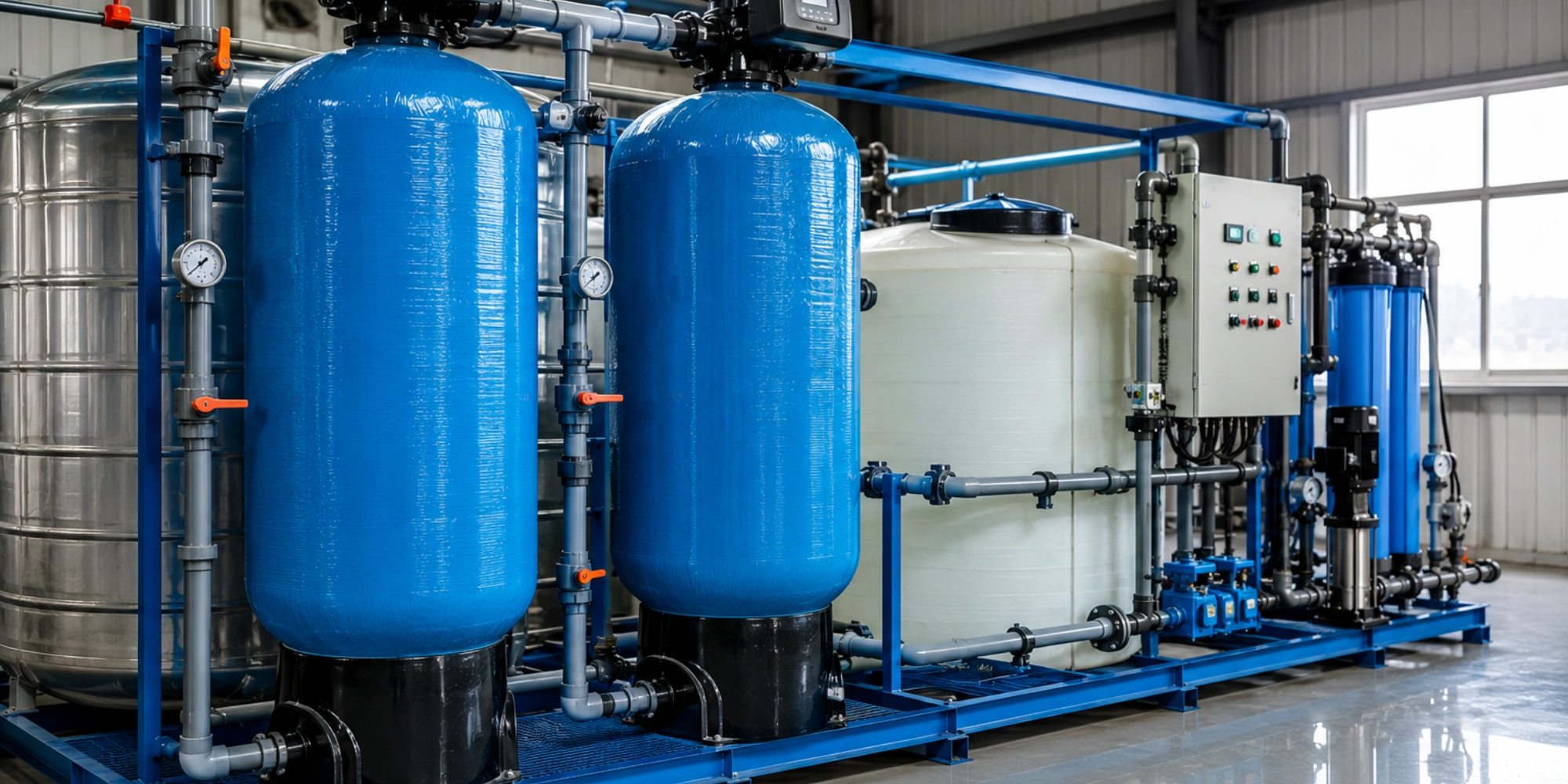
Water softening systems lessen hardness through techniques like cation exchange. In an ion exchange water softener, water flows through a resin bed containing exchange sites that bind sodium or potassium. Calcium and magnesium ions bind to the resin and, in the process exchange, sodium or potassium ions. The EPA considers cation exchange a proven technology for water softening, and that under the right conditions, softening by cation exchange technology is able to achieve very high contaminant removal for scenarios involving posiatively charged contaminants. In a softening system, the resin is regenerated by passing a concentrated solution of salt through it. This means that while a water softener is not a filter that simply collects dirt, it is a device that actively treats water by changing the ion balance of the water.
How Water Softening Works
Conceptually, this is not complex, so I will explain this in terms of a parking garage.Let the resin beads represent the majority of the available parking spots. Give the resin beads a limited number of parking spaces and populate that parking space with sodium ions. As hard water flows through this system, the resin beads prefer the bond of calcium and magnesium ions, so those ions replace sodium, and as hard water passes through, the resin beads release sodium into the water, making the water leaving the softening system less hard. There is a threshold of water a resin bed can soften. When that water is treated, that resin bead reaches saturation, and the softening system must regenerate the resin using a concentrated brine solution, which reverses the exchange. EPA has stated that in general terms, cation exchange softeners exchange the hardness of calcium and magnesium with sodium or potassium.
The benefits of softening water extend far beyond softening, as the removal of minerals that cause scale results in a reduction of deposits on surfaces and in equipment. The removal of minerals that cause hardness also changes the hardness of water as it reacts with soaps and detergents. With reduced mineral residue, washing and rinsing may result in items being cleaner, such was the case for dishes and glassware, as well as befits and other fabrics. This process is not magical; it merely changes the chemistry of water to bring hardness issues under control.
-
Reduces Scale Buildup
Water softening systems fight scale on many fronts. The white, chalky residue that forms around faucets and shower heads is from the hard water that comes in contact with heating elements, pipes, bathing appliances, and other fixtures. When water is heated, the hard water minerals become deposited on surfaces as hard water scale. According to the USGS, heating hard water leads to the formation of deposits of calcium carbonate in equipment leading to a reduced life of equipment, increased heating costs, decreased water heater efficiency, and a realization of increased costs due to clogged pipes. The operational function of a water softening system eliminates calcium and magnesium from the system, thus preventing hard-water scale build-up.
You could compare the scale build-up to interior plaque build-up in a water pipe. Eventually, it will reduce water carrying capacity to the extent that there will be low pressure and flow throughout the pipe. EPA technical guidance supports the other in that scale is a build-up of plaque in water heaters, pipes, appliances, and equipment that reduces the flow of water. Hard water conditioning is essential to prevent build-up of scale. Instead of continuous (and expensive) attempts to clean the build-up with vinegar or descaling solutions, a water softener eliminates the minerals responsible for calcium and magnesium scale in a prejudicial manner.
Protects Pipes and Plumbing Fixtures
There are many issues with hard water. The buildup of minerals and salts causes blockages in pipes and reduces water flow in fixtures. It takes much effort to clean and maintain plumbing fixtures due to the reduction of water flow. Scale buildup and the reduction of water flow in plumbing are the results of using hard water according to the EPA. A softening system must be installed before the water can enter the plumbing system in order to minimize scale buildup.
With hard water plumbing systems, softening water is effective because the plumbing systems that are behind or beneath walls of the house cannot easily be accessed. Once fixtures have been installed, all the pipes located behind the walls cannot be easily removed for cleaning. It makes more sense to soften the water before buildup begins than to wait until all water pipes and fixtures have been completely blocked and damaged. Although it is not a complete solution to all plumbing issues caused by hard water, softening water makes the plumbing maintenance system more effective.
-
Improves Appliance Performance
There are some conflicts that can occur in your household due to hard water. Heating appliances are the most affected by hard water. Heating water causes hard water to produce minerals that stick to surfaces. The USGS suggests that hard water can reduce the efficiency of electric water heaters and even shorten the life span of household equipment. The EPA indicates that the minerals will start to cover the heating elements of devices and will inhibit the transfer of heat. All of these mineral deposits will cause performance issues for appliances. Water softeners reduce the performance issue related to minerals.
Let's say we have a water heater. The heating element of the water heater is designed to transfer heat to the water efficiently. However, if there is mineral buildup, that will act like an unwanted layer of insulation. This will cause the device to work very hard to transfer the heat, and the mineral buildup will continue to accumulate. There are other reasons for appliance failure besides buildup of minerals. However, water softening can be useful as a protective measure in homes with significant hardness and multiple water heaters.
Helps Water Heaters Work More Efficiently
Water heaters require special considerations because they mix hard water with heat, a combination that encourages the formation of scale. As water is heated, mineral deposits are formed on the heater. These do not only obstruct the transfer of heat, but also lead to equipment inefficiency. The EPA and USGS both agree that scale is an issue for water heaters and heating efficiency, respectively. You can control hardness by softening water which, in turn, controls the amount of scale that can accumulate. This can improve the efficiency of heating equipment and can reduce the need for costs associated with mineral scaling. The extent of the energy savings is dependent on the severity of the hardness, the existing condition of the equipment, the type of water heater, and the operating temperature and many other factors. Therefore, water softening should be considered the control of scale and the protection of equipment rather than providing a guaranteed percentage energy savings for each residential customer.
-
Helps Soap and Detergent Work Better
Have you ever felt as though soap was not lathering well even though you used an abundant supply? Hard water could be the problem. Calcium and magnesium in hard water react with soap and form an insoluble substance called soap scum. According to the USGS, hard water results in the formation of scum on surfaces, and increases the quantity of detergent needed because of the minerals that interfere with the process of lathering. Soap scum formation will be significantly reduced if hardness is reduced. This can make people's normal washing routine feel different.
Hard water doesn’t just affect your sense of cleanliness when using the restroom. Dishwashing, general household cleaning, laundry, and handwashing are all impacted by hard water. The EPA claims that hard water inhibits the lathering action of soap, thereby prolonging bath or shower times. Moreover, hard water does not rinse away soap and dirt from clothes as well as soft water does. If you live with hard water, you may have learned to overcompensate for its effects and add more soap to your loads. With soft water, you can reduce your reliance on detergent. However, it's important to note that people shouldn't slash their detergent use in half on day one. It can take some time to figure out the right amount of soap to use considering the machine you’re using, the hardness of your water, and the amount of soil you're trying to remove.
The impact of soft water is particularly noticeable with bar soap. In hard water, bar soap hits a dead end. The soap reacts with magnesium and calcium and forms a soap scum. In soft water, the same soap scum reaction is much more reduced, thereby prolonging the effectiveness of the soap. According to the USGS, soft water lets you clean things with a more concentrated lather. The result is less soap and easier cleaning.
-
Makes Laundry Cleaner and Softer
Hard water affects laundry in several ways. Minerals in hard water prevent soaps and detergents from completely clearing fabric and leave a sticky, unpleasant residue. As the fabric is washed, minerals and soap deposits change the softness and appearance of fabric. The USGS (United States Geological Survey) reports that hard water results in the premature ruining of fabric, clothes, and other textiles. Water softeners remove calcium and magnesium which aids the absorption of soaps and detergents.
Softens Fabrics
The goal of washing laundry is to remove dirt and sticky, unpleasant residue. Hard water is difficult to defeat because hard water minerals combine with soap and detergent in the washing process. A softened water supply decreases mineral residue during washing. It also leaves fabric feeling more clean and stiffness in towels and clothing is reduced in homes with hard water.
As a result, less detergent is needed. Reducing detergent use saves money in the long-term. The washing machine and detergent will dictate the ideal amount, but the principle is consistent. Water hardness affects cleaning chemistry. For the household, it is better to soften water to counteract hardness, as opposed to wasting money on excessive detergent.
-
Easier maintenance of bathrooms and kitchens
Water softening makes household maintenance easier by eliminating the need to scrub white deposits from shower doors and other surfaces. When water evaporates, it leaves hard water minerals behind to form deposits that leave glass cloudy and leave behind spots on fixtures and chalky build up around faucets. According to the USGS, cloudy dishes and glassware are examples of residue caused by hard water. According to the EPA, plumbing fixtures and appliances are impacted by the scale and mineral deposits.
Residue from hard water contains minerals that are largely eliminated by the water softening process, leaving behind less material to form stubborn spots. While softened water homes still require routine cleaning, the elimination of hard water minerals can help make spots much easier to remove. Soft water is generally less harsh on glass shower doors and kitchen glassware than hard water. In households with a large number of people, this can bring about a large change in the amount of cleaning required.
-
Can Improve Skin and Hair Feel
The benefits of soft water become apparent in the way it feels during bathing. Insoluble soap residue due to the reaction of hard water and soap can leave soap scum on surfaces and skin. Soft water is able to effectively clean by washing away soap residue, and according to the USGS, the slippery feel after washing with soft water is actually soap residue, and once the hard water minerals are removed, the soap breaks down and forms a slippery film, giving the "slick" feeling described by users. This feeling is indeed due to the absence of hard water minerals, so a different shower experience may be felt with the same soap.
Why Soft Water Changes the Washing Experience
People who use hard water often feel the slippery film caused by soft water and believe they have not sufficiently rinsed. However, the opposite is true, as hard water leaves behind more soap scum. The USGS also states that the "squeaky clean" sensation caused by hard water is due to soap curd remaining on the skin. Thus, softened water bathing actually offers a smoother bathing experience over hard water.
There are limits to how much this benefit can be stressed. Water softening systems are not meant to replace medical treatment for skin conditions. Some people see a lot of improvements, while others notice no difference at all. Improving water quality by reducing hardness is the primary purpose. That said, washing with softened water makes a huge difference for people who experience soap scum buildup, mineral residue, and the difficulty of rinsing soap away.
-
Can Prolong Life of Water Appliances and Plumbing
Hard-water scale builds up in all plumbing and water apparatus, which reduces their efficiency over time. Hard water, per EPA's WaterSense, causes scale buildup in plumbing and appliances. Scaling can lead to a number of problems that reduce the efficiency of the plumbing systems and appliances in the home. Water softening systems reduce water hardness at the property's incoming water, which can create a less scaly environment.
This is most noticeable for households who own expensive water-related equipment. A water heater, shower, and dishwasher that require increased maintenance is a burden, all of which can be caused by mineral buildup. No water softening system can guarantee that any appliance will last a certain number of years, but equipment subject to mineral buildup will last an unknown number of years longer.
The impact may be even greater on a business level. Long operating hours of multiple water-using systems may be present in restaurants, hotels, laundries, hospitals, manufacturing facilities, and other similar businesses. In such cases, scale control may be required in order to maintain business operations. According to the EPA’s commercial WaterSense guide, water softening is used in applications involving boiler feed water and as pretreatment for other water purification technologies.
-
May Improve Water Taste and Appearance
Some users report a change in the taste and feel of water after the removal of hardness. The EPA report on the selection of water treatment systems states that the reduction and/or removal of scale forming minerals can improve taste and mitigate the effects of hardness on plumbing. The effect can vary significantly based on the original chemistry of the water and the perception of the user, and therefore, cannot be considered improvement across all instances.
There is also the distinction between softening and purifying. The focus of an ion exchange softener is the removal of hardness minerals. As per the CDC, water softeners do not impact the removal of protozoa, bacteria, viruses, or other contaminants, although it can be configured to remove other contaminants. If you have a water issue relating to pathogens, nitrates, arsenic, lead, or other contaminants, you need specific treatment appropriate for that contaminant. A softener should not be purchased with the belief that it improves the quality of all other aspects of the water.
-
Benefits Commercial and Industrial Operations
Mineral build up becomes a significant problem at the commercial or industrial scale. What might just be a nuisance in one household appliance, can become a much greater concern in industrial processing equipment, such as boilers, heat exchangers, cooling systems, industrial laundries and food-service equipment, or manufacturing equipment. The EPA WaterSense states that softening is a technology used as boiler feed water treatment and as a pretreatment to other forms of purification. Softening or removing the hardness of the water can control the build up (or scale) in sensitive equipment, therefore providing a more stable operating environment for the facility.
Treating water on an industrial scale explains the reasoning behind the consideration of hardness. There is rarely a situation in which a softener is the last treatment in a train of processes which may incorporate filtration, reverse osmosis, deionization, disinfection, or any other treatment technology. Softening may actually allow other treatment processes to act more predictably by addressing the hardness concern in the equipment. Designing the best treatment system involves water analysis and understanding the particular processes, rather than selecting the largest softening system available.
Selecting a Water Softener
The first step to selecting a water softener is to ask yourself if your water actually needs to be softened? The EPA states that softeners should never be installed where water hardness is not an issue. Therefore, it is better to have your water tested than to base a purchase on what your neighbor may have bought or what you read in an advertisement.
Traditional softeners pose an efficiency concern due to their regeneration process; both salt and water are consumed in the process. The EPA's current WaterSense policy states that regeneration of significantly both water and salt should be taken into consideration when designing systems for water savings and salt efficiency. More efficient regeneration systems can be demand-initiated as opposed to regeneration systems based on a predetermined schedule. The EPA’s current home-maintenance policy suggests that users increase regeneration system efficiency by programing the system to regenerate based on the level of hardness in the water and/or flow, as opposed to following a predetermined schedule.
| Factor | What to look for |
|---|---|
| Water hardness | Test the incoming water first |
| Household demand | Choose capacity based on actual water use |
| Regeneration | Prefer demand-initiated regeneration |
| Water efficiency | Compare water used per unit of hardness removed |
| Salt efficiency | Compare hardness removed per pound of salt |
| Certification | Look for appropriate recognized standards |
| Maintenance | Consider cleaning, salt replenishment, and servicing |
| Installation | Follow plumbing and local requirements |
Efficient use of salt enhances the operational flexibility and reduces the waste stream of residential users, as well as the discharge of sodium chloride with wastewater. This is of particular importance near wastewater treatment plants, septic systems, and other environmental discharge limits. An efficiently designed system can improve the benefits offered and the sustainability of the system as well as the reduction in resource use.
What are the Cons to Water Softening?
While water softening provides benefits to residential users impacted the most by hard water, water softening systems do have trade-offs. Conventional softening systems use salt and must be regenerated, and water is consumed during this process. The EPA has stated that water softener use can lead to high water and salt discharge, and discharge of sodium and chloride can pose challenges in some cases. For this reason, the best softening system isn't the largest system installed. That is the system that best meets the water hardness and the demand placed upon that system.
Increased system sodium is also a concern. Since softeners largely use salt or potassium to replace magnesium and calcium, softening will also change the mineral composition of the water. Homeowners should discuss the safe level of sodium for drinking water with their healthcare professional and consider what kind of drinking water supply they may need based on their water chemistry and household needs. It may also be appropriate to soften some water while leaving others unsoftened.
Maintenance is also key. Salt levels need to be checked and the brine tank cleaned. The system must also be properly programmed. The EPA advises regular professional maintenance to address salt levels, salt bridges, and the cleaning of the brine tank. A neglected softener can be inefficient or stop controlling the level of hardness altogether. In other words, all components of the system—selection of the correct softener, its installation, programming, and eventual maintenance—impact how water softening is achieved.
Conclusion
The main advantage of water softening is the control of hard water minerals—especially calcium and magnesium. Water softening reduces hardness, which, in turn, prevents or limits scale formation in piping, water heaters, and water-using appliances. In addition to better operation, soap and detergent require less utilization, which results in better housekeeping and better spot-free glassware. There is more efficient use of soaps and detergents in laundering, which yields softer, brighter fabric with fewer spots on clothes. In the commercial and industrial realms, scale can interfere with the operation of boilers and heat transfer systems, and additional hardness control is justified. The EPA and USGS frequently list hardness scale control and improved performance of soaps and plumbing protection as primary soft water benefits.
Still, automatically buying a water softener should be avoided. Test the water, see if hardness is significant enough to concern you, then check the systems based on capacity, salt efficiency, water use, regeneration method and how much they'll cost to own. Keep in mind, modern demand-initiated systems regenerate less than fixed schedule systems, and smart programming of previously mentioned systems can even improve resource use. Also keep in mind that water softener systems are built to specifically address hardness, so do not expect a softener to remove pathogens, or undesirable compounds that aren't easily described as 'Hardness' in water.
The reason water softening systems are so widely used is because hard water causes scale and fouling throughout a household and leaves behind a burden that is difficult to clean, negatively impacts valuable equipment, and generally creates annoyance in maintaining hard water dominated convenient systems. Because of this, source removal of hardness is definitely worth the money, as long as it is the appropriate hardness removal system in your situation.